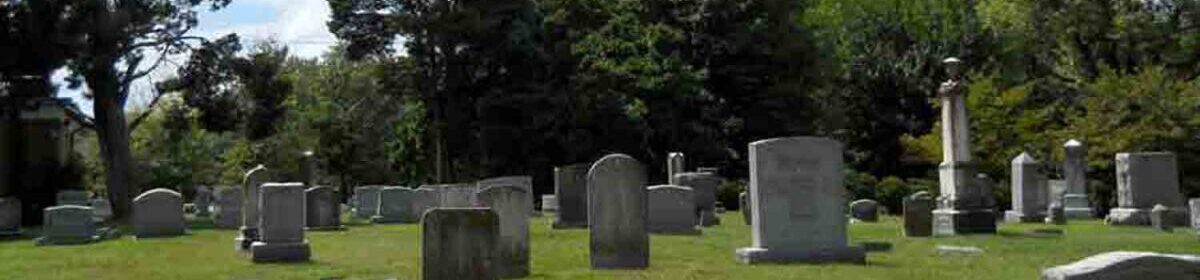
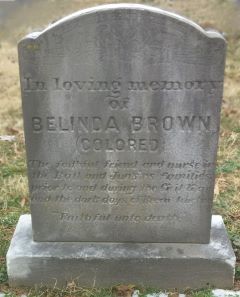
Much of what we know about Belinda Johnson Pierson Brown, starting with the epitaph on her gravestone in the Lewinsville cemetery (pictured above), is filtered through the memories of members of the Ball family. The Balls remembered Belinda, like most of the people they enslaved, as extremely loyal, devoted to “the family” (by which they meant their own family). The information about Belinda’s life the Balls relay in the epitaph and in a 1930 memoir by William Selwyn Ball, Reminiscences of an Old Rebel, seems to be mostly accurate. However, because the focus in these accounts is so much on Belinda’s relationship with the Balls, there are notable gaps; for instance, they do not include Belinda’s birth and death dates, or the names of her parents and children.
Some of those gaps can be filled in using official documents, especially the 1870 census, taken on July 16, which was the first one to recognize formerly-enslaved people as citizens rather than property, and the record of Belinda’s July 23, 1870 marriage to John Brown (another form of legal documentation available only after emancipation). Based on those records, it appears that Belinda was born between July 24, 1831 and July 15, 1832 in Fairfax County, Virginia to William and Nancy Johnson (the census and marriage records both give her age as 38, and the marriage record includes her parents’ names and her place of birth). It also appears that she had an earlier husband with the last name Pierson (her surname in the marriage record; in the census, she is Belinda Johnson). At the same time, important facts about Belinda’s life remain a mystery, at least to those of us at Lewinsville. Most notably, we don’t know how many children she had, what their names were, or whether she has living descendants.
We know that Belinda had children, and that they played a central part in her later life, because she mentions them in two surviving documents that provide more direct, though still mediated, access to her own voice: two dictated letters from Belinda to William Selwyn’s older sister Rebecca Ball Addison, preserved by Rebecca and reproduced in an appendix to William Selwyn’s memoir. The letters, dated 1892 and 1894, must be read with their context in mind: Belinda was communicating with someone with considerably more power in the racial and economic hierarchy, a member of the family that owned the land on which she lived. In addition, lacking the ability to write, she had to rely on others to put her words on paper. Despite these limitations, the letters give us a sense of Belinda’s personality, including her willingness to assert her independent judgement and her strong attachment to those she considered her “own” kin.
The 1892 letter finds Belinda staying at 1302 30th St. in Richmond, apparently the residence of one of her children, during a 3-week January visit. While Belinda expresses interest in seeing “Miss Rebecca” (who lived in Richmond for most of her adult life) while she is in town (either again, or at all; it’s not clear; both women have been sick, and there’s some indication that Rebecca’s husband isn’t entirely comfortable with Belinda visiting), the main focus of Belinda’s visit seems to be her own family: her “dear children” and “kin folks here from the country.” Belinda does not name the children she has been visiting in the letter (but mentions at least two, or maybe a child and his or her spouse), but she does say that she has “had a happy time” with them, even though she has been sick.
Belinda also answers what was apparently an inquiry by Rebecca into her spiritual welfare, which probably included encouragement to formally join a church: “I am striving to be as good as I can, but you know the African race is not as bright as yours & of course there cannot be as much expected of them, but I am trying the best I know how, to live differently and feel that this is a change.” “But Confirmation is a very serious thing,” she continues, “I do not think it is the form but the feeling that makes us good, so I want to make sure that before I act – that – I am safe in doing so.”
This second sentence, which contains some fairly sophisticated theological reasoning (couched in language which, like the rest of the letter, suggests that Belinda and/or her amanuensis, whom she identifies as one of her children, were comfortable communicating in a linguistic register similar to that used by the Balls), belies Belinda’s earlier statements about the intellectual capabilities of “the African race” – a reminder of just how complex the communication between these two women was. Belinda seems willing to answer the inquiry, perhaps for the sake of maintaining a relationship with someone she believes means well, and who may also hold some continuing power over her. She is also willing to at least bow rhetorically to White supremacist understandings of their relative places in a racially-determined intellectual hierarchy (which apparently, in Rebecca’s mind, supersedes the convention that age brings greater wisdom, and the prerogative to advise; Rebecca, born c. 1840, was 8 or 9 years younger than Belinda). At the same time, Belinda seems to use that allusion for her own purposes (fending off further attempted interference in her life choices), has her own well-considered ideas about her faith, and is comfortable asserting them and following her own judgment about whether she should formally join a church.
The second, 1894 letter is written from Woodbury, the Ball’s property in Fairfax County, where Belinda and John were living. There is no indication of who took Belinda’s dictation (though it appears that that person may have added some comments of his or her own in parentheses). Belinda reports that she is in “middling” health, and that “my own children & my neighbors are so kind and do not let me suffer for anything. Miss Martha [William Selwyn’s wife] came over early Sunday and brought me fresh fish – hot green tea with real cream in it – & some of my own kind of corn bread made by her own dear hands, so you know I must have enjoyed it.”
Belinda’s references to “my dear children” and especially “my own children” in the letters contrast with William Selwyn’s portrait of her in the body of the memoir. His anecdotes there, like the letters, give a sense of Belinda’s personality, but always in the context of his memories of her as the faithful servant of the Ball family. For instance, William Selwyn remembers the woman he knew as “Beedy” as “full of fun and sentiment.” She “would do anything she could,” he writes, “to comfort or please ‘her children’. She had a sweet voice, and one night after supper, she marched into the dining room, her hair filled with lightning bugs and singing ‘Bright gems were in my hair, how I hated their brightness, etc.’.” In Ball’s memories, he, his siblings, and his cousins are Beedy’s children, the primary objects of her care. The quotation marks he places around “her children” suggest that he remembers her calling them that, and in fact she does seem to refer to Rebecca and her family as “my children” in the 1894 letter. At the same time, in her letters to Rebecca, Belinda repeatedly and perhaps somewhat pointedly refers to “my dear children” and “my own children,” apparently using the phrase “my neighbors” to refer to William Selwyn and his wife in the 1894 letter. While she clearly expresses warm feelings for the Balls, she also emphasizes in her letters to them the importance of her relationship with her own kinfolk — biological or possibly step or chosen, but in any case people she claimed as her “own” in a way that she did not claim the Balls, even in direct communication with them.
William Selwyn’s memories of Belinda’s prewar marriage are similarly mediated through the Ball family’s interests. By his account, Belinda was married “shortly before the war” in “a lovely ‘white people’s wedding’” to “a half mulatto named Silas.” The couple “went with the family when they refugeed” south during the war. However, “just before the close of the war,” Silas committed what William Selwyn saw as an act of “treacher[y]”: “he took the single wagon and horse and went around the neighborhood in Albemarle, begging for provisions for Miss Dolly [William Selwyn’s aunt, Dorothy McCabe Ball], and immediately set out for Washington, sold the horse and wagon in Culpeper Court House, and was never more seen.” William Selwyn writes that Belinda “was greatly grieved at her husband’s conduct and never wanted to see him again” (66-67). He does not, however, seem to consider that the possibility that Belinda might have been upset at Silas’ leaving her, and/or leaving her behind, rather than at his leaving the Balls (or appropriating the horse, wagon, and provisions for his own purposes).
William Selwyn recounts that after Belinda returned to Fairfax County with Dorothy McCabe Ball and her surviving family (Dorothy lost her husband William W., mother-in-law Martha, sister-in-law Lucy, and two sons during the war), Belinda, like members of the Ball family, lived in one of the cabins built during the war as quarters for soldiers within a fort that was erected on the Ball property (the dwellings present on the property before the war, William Selwyn explains, had been “pulled down for the material in them”) (pp. 61, 66-67). This must have been a difficult period for Belinda. In addition to whatever questions she may have had about why Silas left as he did and whether he would return, she was often the sole mature adult in a household through which William Selwyn, his cousins, and their friends, all former Confederate soldiers traumatized by war and defeat and trying to find their bearings in a changed world, apparently circulated at whim, doing enough work to keep themselves in drink and food, but little else. By William Selwyn’s own account, they regularly drank to excess and engaged in other risky behavior. “It is nothing short of a miracle,” he writes, “that some of our escapades did not end in tragedy” (p. 68).
He also recognizes the toll their behavior took on his aunt, writing “I wish I could portray the indomitable courage, energy and faith of Aunt Dolly in that year following the close of the War when we boys were not what we should have been” (p. 62). At the same time, he records that Dolly was often away from the household (staying with friends in D.C., working on reestablishing legal title to the Woodbury tract, gathering funds to build a new house, and perhaps also escaping from the unsettled situation in Virginia): “fortunately Aunt Dolly and Martha were away from home a great deal during that year following the close of the war, but it was unfortunate for us boys!.” He then goes on to remember that Belinda was steadily present, but does not recognize that the “boys’” behavior, and the scarcity of food and other necessities they all faced, would also have taken a toll on her. He records Belinda’s presence with a brief sentence that does not even acknowledge her legal status in 1866: “we had old Belinda with us, a devoted slave” (p. 64).
Adding to the difficulty of the situation for Belinda would have been the young men’s continuing embrace of their “Rebel” identity. While William Selwyn’s memories of the “worse than wasted year following the close of the war” focus mostly on drinking, dancing, and tournaments, he mentions several occasions on which he and his companions openly identify or act as Confederates, including one incident where they terrify a carpenter they have hired to build a roof by telling him that they are members of Mosby’s Rangers. On another occasion, they attack “a fort” “at the top of the Falls. . .manned by colored troops”: “up the hill and into the fort we charged, giving the rebel yell at every jump.” William Selwyn acknowledges that the troops could easily have fired on them but did not: “why we were not shot down has ever been a wonder to me” (pp. 63-64).
Freedman’s bureau documents record additional incidents of violence against Black residents in the Langley/Lewinsville area during October and November 1866, some of them apparently involving residents at Woodbury. In a report, Superintendent O.E. Hine records an assault on freedmen Allen Gunnell and Dick Odrick near Chain Bridge, an “attempt[ ] to break up the religious meetings held at the house of Robert Gunnell (colored) in Langley,” the vandalism of a school for freedpeople in Lewinsville, and the burning of a similar school near Frying Pan Church. According to Hine, William Selwyn’s older brother Mottrom Dulany “Mott” Ball was among a “gang of ruffians who all live in the vicinity of Langley” who “annoyed” and “disturbed” the church gathering and “committed many other petty outrages.” William Selwyn remembers his brother Mott, who in fall 1866 was a thirty-one year old married lawyer with two children and another on the way, living at Fairfax Court House immediately after the war (p. 62). From Hine’s account, it appears likely that Mott also spent time in the household at Woodbury. So this was the context in which Belinda was attempting to survive, and perhaps, like Dolly, who conducted morning and evening “family prayers” when she was present (p. 62), to create some semblance of order and safety for other members of the household as well as herself. While the reference to the “dark days of Reconstruction” in the epitaph the Balls crafted for Belinda employs common Lost Cause phraseology, Belinda might well have agreed, for different reasons, with that description of the period.
It was also during this period, or soon after, that Belinda began her relationship John Brown, whom William Selwyn calls “a fine man, and suitable to [Belinda’s] age.” “They became mutually attached,” William Selwyn recalls, “and desired to marry, but [Belinda] would not consent unless she could be divorced from Silas” (p. 67) – an idea that may have been sparked in part by Belinda’s awareness that the Balls’ neighbor (and Lewinsville member) Mary Lee Jones Beall was during the same period seeking a divorce from her long-estranged husband William. Instead of assisting with a legal divorce, the Balls stepped in to facilitate what they considered an appropriate match by assuring Belinda that “a law had annulled all slave marriages” (p. 67). This was not the case; in fact, the Freedmen’s Bureau created official records of marriages contracted during slavery to give them legal status.
Belinda may have been convinced by the Balls’ argument, or she may have decided that, although she would have preferred to exercise her newly-gained rights and responsibilities as a citizen via a formal divorce, accepting the workaround the Balls offered was the best course open to her. As with her later musings over church membership, she may have decided that “feeling” (her recognition that her earlier marriage to Silas was over) could prevail over “form” (legal technicalities).
According to the marriage record, Belinda represented herself as a widow with the last name Pierson. That could indicate that Silas’ last name was Pierson, or that she had had an earlier partner, perhaps deceased, with that name.
William Selwyn Ball provides some additional information about Belinda’s family, including that she had siblings named Dennis, Mary, and Dolly, all of whom shared the last name Johnson (p. 65). It’s possible that they were, indeed, siblings, or at least blood relatives. If so, it appears that they and Belinda were separated from each other, and possibly also from their parents, at some point relatively early in Belinda’s life. Enslaved people with the names Dennis, Mary, and Dolly appear in the Dec. 1842 inventory of Mottrom Ball’s estate. All three are assigned valuations in the $200-$300 range, suggesting they are of similar age, possibly older teenagers or young adults who would be at or approaching prime working age, and valued accordingly. The same three names, paired with somewhat increased valuations, appear in a Dec. 1850 agreement dividing enslaved people from Mottrom Ball’s estate among the heirs. Belinda’s name, however, does not appear in these documents. In addition, while there are people named Nancy and William in the 1842 and 1850 lists, their apparent ages, based on valuations, suggest that they are probably not a couple, or the parents of Dennis, Mary, and Dolly (Nancy is assigned a value of $0 and described as “old” and “a charge,” indicating that she is no longer capable of substantial labor; William is assigned a relatively high value of $400, suggesting that he, like Dennis, Mary, and Dolly, is of prime working age, and may have additional skills, though he is not, like several others on the list, described as having a trade such as carpenter or blacksmith).
“One negro woman named Belinda” is, however, named in a Jan. 1850 document in which William W. Ball (son of Mottrom, husband of Dorothy/Dolly, and uncle of William Selwyn) transfers pretty much everything he owns into a trust apparently designed to consolidate William W.’s debts and prioritize the interests of certain creditors over others. The trust includes all of William W.’s interest in the estate of Mottrom Ball, as well as additional property that does not fall in that category. Belinda is listed in a way that indicates she falls in the second category (and in fact is the only enslaved person listed that way). Belinda may also appear under William W. Ball’s name on the slave schedules of the 1850 federal census; that document, recorded on Oct. 2, 1850, lists two 18-year-old Black women among the people William W. Ball claimed as property. In March 1858, Belinda was grouped with Dennis, Nancy, and others in another trust agreement which appears to transfer William W’s interest in the enslaved people named in the document to his wife, Dorothy H., and her children.
So it seems that, by the 1850s, William W. Ball claimed a woman named Belinda, probably the same person who married John Brown in 1870, and about whom William Selwyn Ball wrote in his memoir, as his property. It also seems that Belinda, unlike most of the people William W. claimed as property, was not considered to be part of the estate of William W.’s father, Mottrom Ball, but instead came into his household in some other way. The trusts created in the 1850s appear to be designed primarily to protect William W.’s wife and children from the consequences of his legal and financial troubles. They may also have provided some protection to the enslaved people they named against sudden seizure by a creditor, but that doesn’t appear to be their primary, or even a deliberate, purpose; they did not preclude sales, but gave the trustee the right to make the decision, and required some notice for a sale of the property, including human beings, included in the trust.
Belinda’s presence in these documents highlights a question raised by one of William Selwyn Ball’s most interesting memories of her. “On the return to ‘Woodbury’” after the war, he recounts, Belinda “was visited by some of our Yankee neighbors with the information that she was now free and could be educated and have her own home. She dismissed them with scorn,” he writes, replying “I thank you. . .but I have always been free and have my own home, and that I am not educated is entirely my own fault.” William Selwyn sees this exchange as additional evidence of Belinda’s loyalty, introducing the anecdote with the words “she stuck to us all to the very end” (p. 66). He doesn’t, however, comment on Belinda’s statement that she “ha[d] always been free.” Perhaps those words were an existential statement, a declaration that Belinda never felt her identity was subsumed in her legal status. They may also have been an assertion of her right to make her own judgements about her life and actions; as is evident from her later exchange with Rebecca Ball Addison, Belinda apparently didn’t take kindly to people telling her what to do or how to think about herself and her situation, and might say what she felt needed to be said to end a conversation with someone who may have been trying to convince her to leave Woodbury. She may also have found the conversation uncomfortable or even perilous, given that it was apparently witnessed by at least one member of the Ball family. If that was the case, then her declaration that she “ha[d] always been free” seems like a strange choice. It was certainly a memorable statement, since whichever member of the Ball family overheard it remembered it well enough for it to show up in William Selwyn’s memoir sixty years later.
But it’s also possible that Belinda’s words were a straightforward description of what she believed her legal status to be. There is a woman named Belinda among the people Elizabeth Lee Jones destined in her will for transportation to Liberia by the American Colonization Society, or, failing that, emancipation in the United States. Since Belinda Johnson Pierson Brown was born c. 1832, ten years after Elizabeth Lee Jones died, she was not that Belinda — nor, since Belinda Johnson was the daughter of a woman named Nancy, is she that Belinda’s daughter. She could, however, be related in some way; aside from some connections between mothers and children, Elizabeth Lee Jones does not describe the family relationships that may have existed among the people she enslaved. There is at least one woman named Nancy named in Elizabeth Lee Jones’ will, as well as a group of people designated as “the children of Nancy,” who are to be held by Elizabeth’s brother, Thomas ap Catesby Jones, during the interim period between her death and their eventual colonization or emancipation.
At least one member of this group was apparently emancipated; a certificate of free status for Judy Dobson, daughter of a woman named Nancy freed by Elizabeth Lee Jones’ will, appears in the Fairfax County Registration of Free Negroes. Judy was born c. 1819, and had five children when she registered in 1848. She could have had a sister born in 1832. A Nancy Johnson, born c. 1796, daughter of Levinia (or perhaps Levinah or Lavinah) Johnson, who was freed by Ann Smith of Westmoreland County, also appears several times in the registry, as do her mother, sisters, and a daughter, Fanny, born c. 1811. That Nancy Johnson could have had another daughter in 1832.
If Belinda Johnson was born to a free mother in Virginia in 1832, they would have had a particularly complex situation to navigate, since Virginia did not allow freedpeople to live within its borders without specific permission to remain, and began enforcing those restrictions more strictly after the 1831 Southampton uprising led by Nat Turner. Given that context, it is possible that Belinda and/or her mother could have made some arrangement with the Balls that resulted in her enslavement, at least in the eyes of the Balls, their creditors, and/or legal authorities, while Belinda continued to see herself as free. Since she could not read, she might not have realized that the Balls were claiming her as their property in agreements executed in the 1850s.
Whether or not Belinda knew about the trusts William W. executed in the 1850s, or her inclusion in them, it seems unlikely that the Balls could have kept conversations about debts, lawsuits, and other legal and financial troubles mentioned in the 1850s documents entirely out of the earshot of Belinda or other enslaved people living and working in their household. Enslaved people in the Ball household must have known that they, their family members, and other members of their community were in danger of being sold to satisfy debts. They would also have known that, that, in 1850s Virginia, sale was often followed by transportation to the far South, where land recently seized from indigenous people was being transformed into plantations worked by enslaved laborers.
During this anxious period, Belinda must have been going about her work and perhaps bearing her own children. We know from both the epitaph and William Selwyn’s memoir that Belinda worked in the Ball households as a “nurse,” which could have meant wet nursing (breastfeeding the Ball children from her own body, after she had borne at least one child), caring for children in other ways, or both. According to William Selwyn, “she nursed the younger children in my father’s family and in Uncle Waring’s, including the son of her beloved Miss Molly, Uncle Waring’s eldest daughter” (p. 66). Although William Selwyn, born in 1846, was among the younger children of his parents, Spencer Mottrom Ball and Mary Dulany, who were married in 1833 and had 7 children between then and 1852, it’s unclear whether he counts himself among the children whom Belinda nursed. Instead, he may be referring to his younger brother, James May, born in Feb. 1849, and his sister, Anne Corbin, born in Nov. 1852. There are some references in William Selwyn’s memoir that suggest that James May’s birth may have been difficult (p.2), and that he was considered delicate (p. 5); those are circumstances that might have precipitated a search for a new nurse, and perhaps a wet nurse in particular. If so, William Selwyn, who was a toddler in 1849, did not specifically recall Belinda’s arrival in the family at that time.
According to the Ball family genealogy in Mackenzie et al.’s Colonial Families of Virginia (pp. 36-49), William Selwyn’s uncle, William Waring, married Dorothy McCabe (aka Dolly) in 1834, and they had ten children between 1835 and 1855. Their oldest children, including Mary Gray (aka Molly or Mollie), born in 1835, beside whom Belinda is buried, would have been more or less contemporaries to Belinda. The younger ones, including William Selwyn’s wife and first cousin, Martha Corbin Turberville Ball (named after her grandmother), were presumably among Belinda’s charges.
Mary Gray Ball married a Methodist preacher, William E. Judkins, in 1856 and had one son, William Duncan Judkins, who was born at Woodbury in 1856. Mary died in 1858. William Duncan Judkins seems to have lived at least part of the time with his maternal relatives; in the 1860 census, he appears in a household that includes his great-grandmother, Martha Corbin Turberville Ball, and her daughter (and his great aunt) Lucy W. Ball. They are apparently living in a separate dwelling, perhaps a dower house of some sort, adjacent to that of his maternal grandparents, William W. And Dorothy Ball (Dorothy seems to be misidentified in the census entry as Martha, but her age is correct).
Given William Selwyn’s list of the children Belinda nursed, it seems likely that she was also present in this extended household. However, there’s no exact match for her in the 1860 slave schedule listings for W.W., Martha C., or Lucy W. Ball. Those listings, which, like all slave schedules, record sex, race, and age but not names, include one 35-year-old woman enslaved by William W., another 35-year-old woman enslaved by Lucy, and a 30-year-old woman enslaved by Lucy. Any of these three women could be Belinda. The 30-year-old woman, who is listed adjacent to a 30-year-old man and children 9,7,5, and 1, with whom she may or may not form a family grouping, is the closest to Belinda in age, but there is no indication that Lucy ever claimed Belinda as her property. Lucy did inherit enslaved people in the distribution of her father’s estate; they and their descendants are more likely than Belinda to be among those listed as her property in 1860.
As tends to be the case in pre-emancipation records, Belinda’s children are much harder to trace than her White charges (and Belinda herself is traceable in part because of legal documents arising from William W. Ball’s legal and financial troubles). At least based on these documents, we don’t know how many children Belinda had, when they were born, how long they survived, what their names were, who their fathers were, or whether they lived with one or both of their parents during some or all of their childhood (though given that Belinda appears to have been moved between households as the needs of the Ball children and their parents dictated, it seems likely that, if they were born during the late 1840s or 1850s, they experienced at least periods of separation).
We do know, based on Belinda’s own account, that people she considered “her. . .children” grew to adulthood, were living in Richmond and Northern Virginia in the 1890s, and were in close touch with her at that point. Based on Belinda’s marital history, it seems possible that they could have used the last names Johnson, Pierson, or perhaps Brown (as far as I can tell from post-emancipation documents, there is no record of Belinda and John Brown having children together, though that’s certainly a possibility, and, if they did, those children could have been young adults by the 1890s. Silas is also hard to trace; there are some candidates in various Fairfax County records, but I haven’t been able to establish a clear connection between any of them and Belinda, let alone find children of which they are listed as the parents).
The address on the 1892 letter, 1302 30th St. in Richmond, seems like a possible lead. Unfortunately, that address and its residents in the 1890s are hard to trace, since the 1300 block of 30th street was outside the city limits in the early 1890s, and doesn’t appear in city directories until 1897. Even then, the specific address 1302 isn’t present; the earliest census record I’ve found for the address is from 1910, and the earliest directory entry is 1912. Sanborn maps tell a similar, though not identical, story: the 1302 lot, with no structure recorded, first appears in 1905, and it still appears to be vacant of any insurable structure in 1925. Based on information in directory and census records, this also appears to be an area where most residents rented their homes, and moved frequently, often within the neighborhood.
There are some records from the early 20th century of people named Brown living at 1302, including William and Gertrude Mills or Miles Brown in the 1910 census, and Elijah Brown in a 1912 city directory. Both William and Elijah come from families whose histories are well enough documented to rule out the possibility that they are Belinda’s children or grandchildren, though they could still be relatives of some kind.
It’s also possible, of course, that the address was mistranscribed in the typescript version we have of that letter, or that an earlier dwelling at that address, perhaps one that did not meet the criteria for inclusion in directories, was gone by the time the area began appearing in formal records.
So we know some of the details of Belinda’s life, but a number of questions, especially about her early life and possible descendants, remain.
Sources:
Where possible, digital copies of primary sources mentioned in the text have been linked above.
Ball, William Selwyn, Reminiscences of an Old Rebel, including the appendices containing letters from Belinda Brown, is available in photocopy in the manuscript collections of the Virginia Museum of History and Culture (Mss5 :1 B2106:1 ). I also consulted a photocopy, probably derived from the VMHC copy, held in the Virginia Room of the Fairfax County Public Library (Fairfax City Branch).
Mackenzie, George Norbury, and Nelson Osgood Rhoades, editors. Colonial Families of the United States of America: in Which is Given the History, Genealogy and Armorial Bearings of Colonial Families Who Settled in the American Colonies From the Time of the Settlement of Jamestown, 13th May, 1607, to the Battle of Lexington, 19th April, 1775. 1912. Volume II. Reprinted, Baltimore: Genealogical Publishing Co., Inc., 1966, 1995. Downloaded from https://www.ancestry.com/imageviewer/collections/61175/images/colonialfamiliesii-000989_36 .
Page last updated 7/26/2025
